Three Camping Journals That Cover Every Outdoor Adventure
Keeping a record of your time outdoors can turn a simple trip into a lasting memory. Whether you are helping a young camper document their first overnight hike, logging miles on a long-distance trail, or reflecting on a weekend under the stars, a dedicated journal adds structure and meaning to the experience. The 3 Camping Journals set, offered as a Kdp Interior ready-for-upload package, gives you three distinct formats in one download: a Kid’s Trip Diary, a Hiking Log Book, and a Camping Journal. Each serves a different audience and purpose, but together they cover nearly every way someone might want to capture an outdoor trip.
This article walks through what each journal offers, how they compare to other options you might be considering, and where each one fits best. By the end you will have a clearer sense of whether this bundle matches your needs or whether a different approach might suit you better.
What the Three Journals Cover
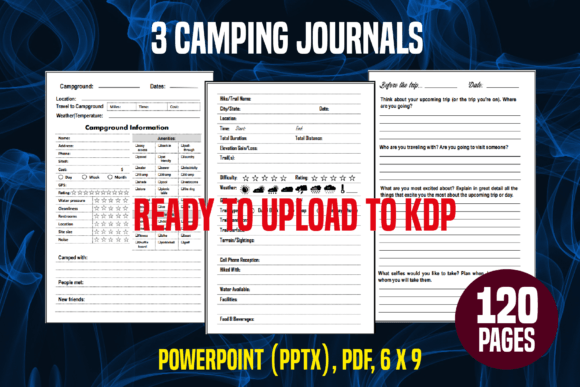
The bundle includes three separate 120-page books, each trimmed at 6 x 9 inches. All files come as a PDF ready for upload to KDP or local printing, and an editable PowerPoint source file is included, which gives you flexibility if you want to customize layouts or add branding. The high-resolution interior means text and images stay sharp whether you print at home or through a print-on-demand service.
Kid’s Trip Diary
This diary is designed for children who are just starting to explore the outdoors. The pages use simple prompts, space for drawings, and short lines for writing. Compared to a standard blank notebook, the guided format helps a young camper focus on what they saw, heard, and felt during the trip. A child who might feel overwhelmed by a plain journal finds clear cues that make recording fun rather than homework. If your goal is to encourage a reluctant writer or to create a keepsake that a parent and child can fill in together, this diary offers a light, structured approach that a general notebook lacks.
Hiking Log Book
The log book is built for tracking specific details: trail name, distance, elevation gain, duration, weather, and notes about conditions. This format appeals to hikers who treat each trek as a data point. Compared to a narrative journal, the log book gives you a quick-reference record of where you have been and how each trail performed. Over time, the pages become a personal database you can use to plan future trips or to compare similar routes. For someone who hikes regularly and wants to see patterns in their outings, this is more useful than a general diary that does not separate facts from feelings.
Camping Journal
The general camping journal leans toward storytelling. It includes prompts about the campsite, meals, wildlife, and reflections on the day. This is the most flexible of the three and works well for family camping, solo trips, or group adventures. Compared to a travel journal designed for city trips, the camping version naturally emphasizes nature observations and gear notes. If you want one book that can hold both practical notes and personal memories, this journal bridges that gap without forcing you into either a data-only or a diary-only format.
How the Bundle Compares with Alternatives
Many outdoor enthusiasts start with a single blank notebook. That approach works, but it requires you to create your own structure. The 3 Camping Journals set removes that friction by giving you three ready-made frameworks. A blank notebook gives you complete freedom, but also leaves you to remember what to record. The guided prompts in these journals reduce the mental effort of journaling, which is especially helpful at the end of a long day when you are tired.
Another common alternative is a single all-purpose outdoor journal that tries to serve both adults and children. Those hybrid books often compromise: the prompts feel too childish for an adult hiker or too technical for a young beginner. By splitting the content into three separate books, this bundle lets each audience use a format that fits their experience level. You are not stuck with one tone or one set of prompts.
Digital alternatives also exist, such as hiking apps and note-taking tools. Apps offer automatic GPS tracking and photo storage, but they lack the tactile experience that many outdoor enthusiasts value. A printed journal never runs out of battery, works in remote areas, and creates a physical artifact you can leave on a shelf. If you prefer analog methods or want to disconnect from screens while camping, these journals are a stronger choice than any app.
Strengths
- Three formats in one purchase. You get specialized tools for different situations rather than one generic book.
- Editable source file. The included PowerPoint file lets you modify prompts, add your own headings, or insert a logo. This is rare in pre-made interiors and valuable if you are a teacher, scout leader, or small publisher who needs to personalize the content.
- Print-ready layout. The PDF is tested on KDP, so you can upload it without worrying about margins, bleeds, or font issues. The trim size and page count match common print requirements.
- 120 pages per book. That length is enough for multiple trips without being bulky. A 6x9 size fits easily into a daypack or glovebox.
Tradeoffs
- No spiral binding option. The files are designed for perfect binding, which is standard for KDP paperbacks. If you prefer a journal that lies flat when open, you would need to print and bind it yourself or use a different service.
- Generic prompts. The Kid’s Trip Diary and Camping Journal use broad prompts that work for most trips, but they may not capture very specific activities such as rock climbing, canoe camping, or winter backpacking. If your trips are highly specialized, you might prefer a niche journal or the editable file to adapt the content.
- Three separate volumes. Having three books means more physical items to carry or store. Some people prefer one all-in-one journal. If you only camp once or twice a year, a single notebook might be more practical than managing three different books.
Kid’s Trip Diary: best for families and young beginners
If you are a parent, grandparent, or educator introducing a child to camping, this diary provides a low-pressure way to build observation skills. The simple prompts work well for ages 5 through 10. Older children may find the format too basic, but for early elementary ages, the combination of drawing and short writing feels achievable. This journal is also useful for scout groups where each child needs a consistent format for recording their outings.
Hiking Log Book: best for regular trail users and data-oriented hikers
If you hike several times a month and want to track performance, trail conditions, or seasonal patterns, the log book gives you a clean, repeatable structure. Thru-hikers, peak baggers, and trail runners often appreciate a log that separates objective data from subjective notes. You can quickly compare one hike to another without flipping through paragraphs of narrative. This format is also helpful for hikers who train for long-distance treks and need to monitor mileage and elevation gain over time.
Camping Journal: best for general outdoor trips and personal reflection
For weekend car campers, RV travelers, or people who enjoy a mix of hiking and relaxing at camp, the camping journal offers the most balanced format. It captures the essentials without forcing you into a rigid template. You can write as much or as little as you want on each topic. This journal works well as a single book for someone who does not need the specialized logs but still wants to preserve their experiences.
Decision Factors to Help You Choose
Before deciding whether the 3 Camping Journals bundle is right for you, consider a few questions:
- Who will use the journal? If one person covers all their trips, a single camping journal might be enough. If you are buying for a household with different needs, the bundle gives each person a format that matches their style.
- How specialized are your trips? The prompts in these books cover general outdoor activities. If your adventures are very specific, you may need to edit the PowerPoint file or look for a niche journal that addresses your exact activity.
- Do you value physical journals over digital? If you already use a hiking app and never miss paper, these books may feel redundant. If you want a screen-free way to record memories, the printed format is hard to beat.
- Are you publishing or reselling? Because the interior is ready for KDP and includes an editable source file, this bundle is a practical option for content creators who want to offer journals to their audience without designing from scratch.
A Note on the Bundle as a Whole
The 3 Camping Journals package works best for someone who values variety and wants to match the tool to the user. Instead of forcing a child to use an adult’s log or asking a serious hiker to write in a general diary, the bundle respects different experiences. That is its main advantage over a single-journal approach.
If you only need one journal, buying the bundle might feel like overkill. However, the editable source file means you can take the Kid’s Trip Diary, change the prompts to fit older children or different activities, and create a custom book without starting from zero. That flexibility reduces the downside of having three books you may not use equally.
For families, scout leaders, or small publishers who want a set of tested layouts they can adapt or republish, this collection offers a practical shortcut. You are not locked into rigid designs, and the trim size and page count follow standard conventions that work across multiple print platforms.
Final Thoughts
Choosing a journal is ultimately about matching the format to your habits. The 3 Camping Journals set covers a wide range of needs in one download, and the inclusion of an editable source file makes it more versatile than most pre-made interiors. Whether you pick one book from the bundle or use all three depends on how many people are recording trips and how much detail they want to capture.
If you are still unsure, start with the Camping Journal for your own use and consider the Kid’s Trip Diary if you have a young adventurer at home. The Hiking Log Book can wait until you start hitting trails regularly enough to miss having a record. All three are available in the same package, so you can decide later once you see which format fits your routine best. Thank you for visiting the store and considering these options for your outdoor documentation.