Finding Your Fit with Easy, Medium, and Hard Jigsaw Sudoku Puzzles
If you have spent any time with classic Sudoku, you know the familiar rhythm: scan the grid, pencil in candidates, and methodically eliminate possibilities within those tidy 3x3 boxes. Then you encounter the Jigsaw Sudoku puzzle. At first glance, it looks like the same 9x9 grid, but the internal boundaries twist into irregular, almost organic shapes. This single change transforms the entire solving experience. Understanding how difficulty levels across Jigsaw Sudoku offerings—from easy to very hard—affect your practice, learning curve, and long-term enjoyment is essential for selecting the right resource for your needs.
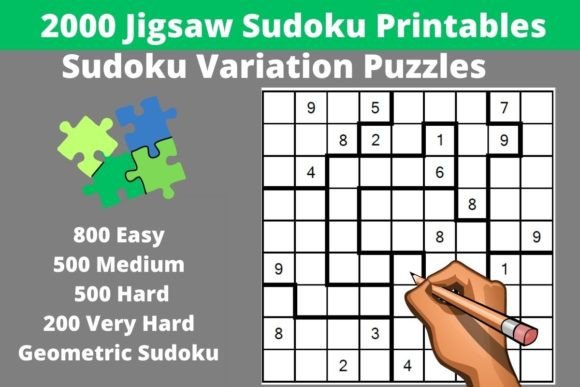
Jigsaw Sudoku, also widely known as Geometric Sudoku, Nonomino, or Irregular Sudoku, retains the foundational logic of classic Sudoku. You still must place the numbers 1 through 9 exactly once in every row and every column. The crucial difference lies in the third constraint: instead of using standard 3x3 square blocks, you work with irregularly shaped regions. These regions can look like snakes, L-shapes, crosses, or any configuration of nine connected cells. Because the shapes break familiar patterns, visual scanning techniques that work well in classic Sudoku often fail here. This demands a more flexible approach to deduction.
What Defines the Spectrum from Easy to Very Hard
The product offering described includes 2000 Jigsaw Sudoku puzzles distributed across four PDF files. The distribution itself tells an important story about what each difficulty tier represents: 800 easy puzzles, 500 medium, 500 hard, and 200 very hard. The volume decreases as difficulty increases, which reflects the reality that harder puzzles require more time, concentration, and often benefit from fewer repetitions in a single sitting.
Easy Jigsaw Sudoku puzzles in this collection typically start with a higher number of given digits, often in the range of 32 to 36 initial clues. These clues are strategically placed to allow you to use straightforward single-candidate deductions and basic elimination. The irregular shapes on easy puzzles tend to be arranged so that at least a few cells align with familiar scanning patterns. You will rarely need to pencil-mark more than two or three candidates per cell. For someone transitioning from classic Sudoku, easy Jigsaw puzzles provide a gentle introduction to the irregular format without overwhelming the solver. You can complete them in the time it takes to solve a medium classic Sudoku puzzle, which makes them ideal for daily practice or for building confidence.
Medium Jigsaw Sudoku puzzles reduce the given clues to roughly 28 to 32. More importantly, the placement of those clues forces you to think across shape boundaries more frequently. You will encounter situations where a number can only go in one cell within a shape, but that cell is not obvious because the shape zigzags across rows and columns in an unexpected way. Medium puzzles introduce the need for more systematic note-taking. Many solvers find that medium Jigsaw puzzles represent the sweet spot: challenging enough to feel engaging, yet structured enough that a focused session yields a satisfying solve within 20 to 40 minutes.
Hard and very hard Jigsaw Sudoku puzzles in this set push into more advanced territory. Hard puzzles often have 26 to 28 given clues, while very hard puzzles may fall below 25. At these levels, the arrangement of clues deliberately limits obvious entry points. You will rely heavily on cross-referencing candidates across multiple rows, columns, and shapes simultaneously. Advanced techniques such as pointing pairs, claiming, X-wings, and even more complex fish patterns become necessary. The irregular shapes in harder puzzles are designed to break symmetry, which means that patterns you rely on in classic Sudoku rarely hold. The very hard tier, with only 200 puzzles, is clearly aimed at solvers who want a genuine challenge and are comfortable with deep logical chains.
How Jigsaw Sudoku Compares with Classic Sudoku as a Resource
When evaluating whether Jigsaw Sudoku puzzles are the right fit for you, it helps to consider what you are looking for in a puzzle experience. If your goal is relaxation and you prefer solving by rote pattern recognition, classic Sudoku with its uniform 3x3 blocks will serve you well. But if you are seeking to strengthen your deductive reasoning, improve your ability to hold multiple constraints in mind, or simply break out of a solving rut, Jigsaw Sudoku offers distinct cognitive benefits.
The irregular shapes force you to think about the grid in a more holistic way. In classic Sudoku, you can often compartmentalize your thinking: focus on one box, then the adjacent row, then the column. In Jigsaw Sudoku, a single shape may span multiple rows and columns, which means that a clue in the top-left corner of a shape could influence a cell in the bottom-right corner of the same shape, several rows away. This interconnectedness trains your brain to process spatial relationships differently. Many solvers report that regular work with Jigsaw puzzles improves their ability to visualize possibilities and reduces reliance on rote scanning.
Another important comparison point is the variety within a single resource. This particular offering includes all four difficulty levels in one purchase, which means you can progress at your own pace. If you are an experienced classic Sudoku solver, you might start at medium to test your adaptation. If you are entirely new to Sudoku logic, beginning with easy and working your way up provides a clear ladder of skill development. The fact that each difficulty has a significant number of puzzles—800 easy, for example—means you are unlikely to run out of practice material before you feel ready to advance.
Tradeoffs and Limitations to Consider
No resource is perfect for every situation, and Jigsaw Sudoku has some tradeoffs worth considering. First, the learning curve is steeper than many expect. Even experienced classic Sudoku solvers can feel disoriented when their visual shortcuts no longer apply. If you are someone who becomes frustrated easily, jumping straight into hard or very hard Jigsaw puzzles may lead to a negative experience. The wise approach is to honor the difficulty tiers and spend adequate time in the easy and medium ranges before advancing.
Second, the physical format matters. This is a PDF digital download that you print on 8.5 x 11 inch or A4 paper. While the ability to print as many copies as you like is a clear advantage over a printed book, it also means you need access to a printer and paper. For solvers who prefer solving on a tablet or phone, PDF files can still work if you have a note-taking app or PDF annotation tool. But if you dislike screen-based solving and do not have convenient printing access, this format may not be ideal.
Third, the puzzle layout on each page is described as one puzzle or one solution per page. This is actually a strength for clarity, but it does mean that if you are someone who likes to have the puzzle and its solution side by side, you will need to flip between pages or print both. On the positive side, having one puzzle per page gives you plenty of room for pencil marks, which is especially valuable for harder puzzles where you may need to write small candidates in many cells.
When Each Difficulty Level Makes the Most Sense
Selecting the right difficulty tier depends on your current skill level and your goals. The 800 easy puzzles are an excellent choice if you are introducing yourself to Jigsaw Sudoku for the first time. They also work well as warm-up puzzles for experienced solvers who want to get into a focused state without deep cognitive strain. Teachers or parents looking for logic puzzles for older children or teenagers will find easy Jigsaw puzzles manageable and instructive.
The 500 medium puzzles should be your primary focus if you have already solved a handful of easy Jigsaw puzzles and want to develop sustained competence. Medium difficulty is where most of the learning happens, because you must actively adapt your strategies. If you are someone who enjoys puzzles during a commute or lunch break, medium puzzles offer a satisfying level of engagement without requiring the sustained concentration of harder tiers. They are also well-suited for group solving or casual competition among friends.
Hard and very hard puzzles are for dedicated solvers who want to push their skills to a higher level. The 500 hard puzzles provide ample material for regular practice at a challenging but not grueling level. The 200 very hard puzzles are best reserved for sessions where you can spend 45 minutes or more on a single grid without interruption. If you are training for a competitive solving event or simply want to experience the most demanding logical puzzles available, these hard and very hard tiers will deliver.
Practical Considerations for Printing and Usage
Since this is a digital download that you print yourself, you have full control over how you use the material. You can print a single puzzle on a sheet of paper and solve it with a pencil, erase mistakes, and reuse the same printout by making multiple copies. The PDF format works on any computer or device, and you can organize the files by difficulty or combine them into custom booklets. The fact that you may print the document as many times as you like means that if you want to solve a particular puzzle again months later, you can simply print fresh copies.
One practical decision factor is paper size. The product is designed for both 8.5 x 11 inch letter paper and A4 paper. Both sizes provide adequate space for Jigsaw Sudoku grids, but the irregular shape boundaries can make cells feel slightly smaller or larger depending on how the PDF scales. If you have a preference for larger cell sizes for easier pencil notation, printing on A4 may give a slightly larger rendering, though the difference is minor. Testing one page from each file after your purchase will help you decide which paper size suits your solving style.
Making an Informed Choice About This Resource
If you are comparing this offering with other Jigsaw Sudoku products, the key differentiators are the volume of puzzles, the distribution across four difficulty levels, and the uncomplicated format of one puzzle per page. Some puzzle books on the market pack multiple puzzles onto a page to save space, which can be frustrating when you need room for notations. This resource leans toward spacious, clear layouts at the cost of having more pages to manage. For solvers who value clarity over compactness, that tradeoff is worth it.
Another point in its favor is the sheer number of puzzles. Two thousand puzzles across four files means you will likely not need to purchase additional Jigsaw Sudoku content for a long time, especially if you solve at a moderate pace. If you finish all 800 easy puzzles and 500 medium puzzles, you will have developed considerable skill and can then tackle the hard and very hard sets with confidence.
However, if you are someone who prefers a progressive learning system with built-in hints, tutorials, or step-by-step guidance, a simple collection of puzzles may feel insufficient. This product provides the puzzles and their solutions, but it does not teach solving strategies. You will need to bring your own knowledge or separately learn techniques such as candidate elimination, X-wings, or shape-based logic. That is not necessarily a drawback—many experienced solvers prefer to figure things out independently—but it is worth noting if you are early in your puzzle journey.
Ultimately, the right resource for you depends on your personal preferences regarding difficulty, format, and independence. If you enjoy the process of discovery and want a large, well-organized library of Jigsaw Sudoku puzzles across all difficulty levels, this offering is a strong candidate. Start with the easy tier to familiarize yourself with the irregular shapes, progress to medium to strengthen your skills, and reserve the hard and very hard puzzles for when you want a genuine mental workout. The 200 very hard puzzles will likely remain challenging even after months of practice, giving you a long horizon for growth.
Take the time to print a few puzzles from each file and observe how your solving approach changes with the difficulty. Pay attention to which level keeps you engaged without causing frustration. That self-awareness will guide you not only in using this resource effectively but also in becoming a more adaptable and confident puzzle solver overall.